• About

webby1dotnet

~ Blogs

webby1dotnet

Monthly Archives: November 2023

What Does it Feel Like to get Vetted by a Guy?

28 Tuesday Nov 2023

Posted by webbywriter1 in aging, exercise, dating, FRIENDSHIP, holidays

≈ Comments Off on What Does it Feel Like to get Vetted by a Guy?

Do guy ‘vet’ girls? Absolutely.

I was recently on a short vacation in my home state and went on a day’s tour of one of our famous national parks. It was fun. For me and all the other tourists! However, I had booked a tour van beforehand, so I didn’t have to drive and could enjoy the scenery.

I was the last one in the van and sat down by a very good-looking guy. I instantly saw that he was a lot younger than me, (oh, sigh!). Still, we spent a lot of the day together, chatting about our respective lives. He had recently broken up with his girlfriend and I concluded he was a) lonely b) slightly depressed and c) looking for someone new.

Anyway, we talked all day, and he told me a great deal about himself. I talked about myself a bit and my work, and we exchanged like stories. Although, certainly, at the end of the day, he had been to more places than I had been and quite certainly had a lot more money.

Here’s where it gets interesting. He spent most of the day either talking to me or following me around. Why? Because I’m fabulously attractive? Well, probably (for my age.) More like, he is lonely and likes to be around a woman. Was he interested? To an extent but he also certainly took note of the crow’s-feet and other wrinkles. He got my email to send me some park pictures, but, I doubt I’ll hear from him again.

It was fun. Was I being vetted? Yes, I was. Did I pass? No, too old. What about him? Cute, right? Very, and sexy. Hmm. But… This guy made his money building a CBD enterprise that was successfully and that he recently sold. How do I feel about that? Well…I’m totally opposed to all CBD products. I have been against marijuana forever and felt that the jury was out about how much real damage this ‘natural, and herbal remedy’ could do. Since I doubt my new friend reads all the health bulletins I read, he probably doesn’t know about the absolute crisis going on in the medical field with older patients using CBD products that combine poorly with their other medications. Patients are having severe adverse reactions to include heart problems, breathing and blood pressure issues. This is drop-dead kind of stuff. So…the data is trickling in as to the effects of this now legal drug.

Bottom line, what does this mean? It means that the two of us have some very significant and fundamental differences in our value systems. Is this important? Very. Men tend to have a very discerning radar for a woman’s beauty and almost any little thing can mar the package. Women tend to be much more sensitive to the man’s character flaws and less on beauty, although, that does matter.

So, seriously, how many relationships fail over beauty issues versus failure over character flaws? Do we  need to think about that one very hard?

So, girls…let me be the nineteenth person to tell you not to fall into bed with Mr. Wonderful after you first meet. The temptation can be very great. And, you may think I say that because you don’t want him to think you are ‘easy’. True, but there’s a lot more to it than that. The guy who pressured you into the sack may think you’re easy or maybe he’s not really all that interested. It can, curiously enough, be that he is very interested, doesn’t have a lot of self-confidence (for whatever reason). He wants you in the sack so you will think of him, not from the neck up, but from the waist down. Maybe he doesn’t feel so great about himself and doesn’t want you to spend a lot of time getting to know him, ‘cause, what will you think then? It is so important to get to know the guy before the fun stuff starts so you can form some kind of idea about who this guy really is.

I did like on my trip, and it was great getting all that male attention. Just as well that I didn’t pass the vetting test. I might have been forced to give him a piece of my mind about all that CBD crap. That wouldn’t have worked, would it?

CEW

P.S.: Final note, if you don’t hear back from the guy in three days, you won’t hear back from him. Oh, sigh.
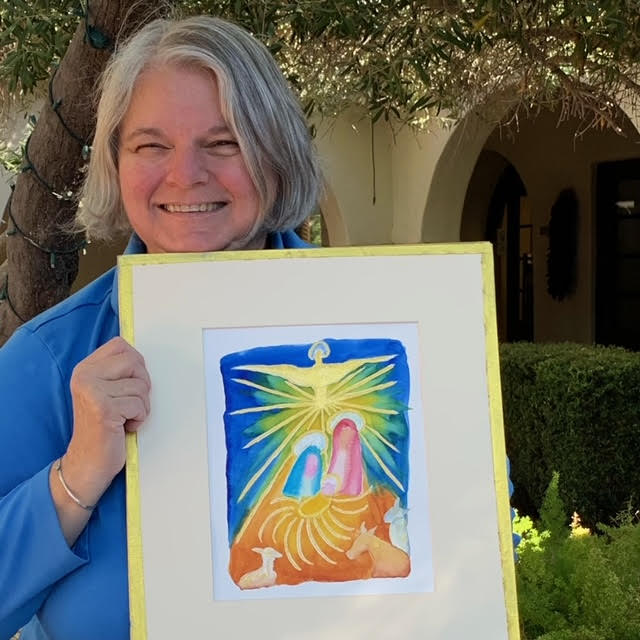

Jeanine’s Art

15 Wednesday Nov 2023

Posted by webbywriter1 in Uncategorized

≈ Comments Off on Jeanine’s Art

Jeanine Colini Design Art

Jeanine’s Nativity watercolor has been selected for the 3rd Annual Creche Festival in Houston, Tx.

Call/text  213.507.5825

Email  jeanine@jcda.com

Shop  https://www.jcda.com/

Facebook http://www.facebook.com/JeanineColiniDesignArt

Instagram  http://instagram.com/jeaninecolini

Fr. Antoine Poidebard – Part II

05 Sunday Nov 2023

Posted by webbywriter1 in Uncategorized

≈ Comments Off on Fr. Antoine Poidebard – Part II

Books and written work

Books: The Syrian Desert with Rene Moaterde and Le Limes de Chaleis. (The Limits of the Roman Empire.)

Poidebard and Felix Marie Charles Moatti collaborated on the influential archaeological and geographic work titled “La Piste Oubliee: A la recherche des tresors de l’Orient (The Forgotten Path: In Search of the Tresures of the East).” The book was published in 1934 and documents their joint aerial archaeological explorations in the Syrian Desert. Poidebard, the aviator, and Moatti, the photographer, used aerial surveys and photography to capture the landscapes and archaeological sites of the Syrian Desert.

This work, often referred to as “The Forgotten Path,” is known for its pioneering contributions to the field of aerial archaeology. Through their aerial photographs and surveys, Poidebard and Moatti documented ancient Roman roads, fortresses, and other archaeological features in the Syrian Desert. Their research shed light on the historical significance of this region and provided new insights into ancient civilizations that once inhabited it. (Retrieved Internet 2023.)

“The Forgotten Path” remains an important reference for scholars and researchers interested in the archaeology and history of the Middle East and the application of aerial techniques in archaeological exploration.

Theories

Poidebard made significant contributions by photographing a number of abandoned Roman forts in the area. His theory at the time was that these outposts of the Roman Empire were to hold back invaders. Although, modern thought has come to deviate from those ideas. (Retrieved Internet 2023.)

The exact timeline and reasons for the Roman withdrawal from regions within Iraq, Iran and Syria varied. In some cases, the Romans voluntarily withdrew to consolidate forces and focus on defending core territories. In other cases, they were gradually pushed out due to military defeats and external pressures. The decline and fall of the Western Roman Empire in the 5th century CE (common era) marked a significant turning point, leading to the eventual fragmentation of the empire’s territories in the Middle East and elsewhere. (Retrieved Internet 2023.)

Cold War satellite images reveal nearly 400 Roman forts in the Middle East

News

By Ben Turner  Live Science Magazine 10/23. https://www.livescience.com/archaeology/romans/cold-war-satellite-images-reveal-nearly-400-roman-forts-in-the-middle-east?utm_term=35FB7B5F-D6F0-4F8F-B

The photos, taken in the 1960s and 1970s by the first spy satellites, reveal that the eastern border of the Roman Empire was a place of vibrant trade.

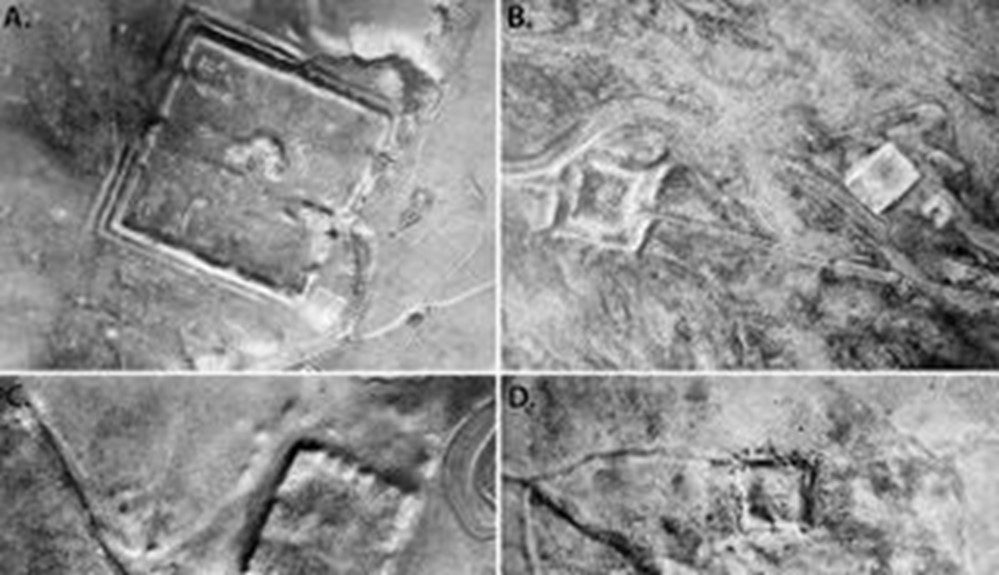
Four roman forts captured in satellite photos by the U.S. military’s Corona project, which ran from 1960 to 1972. (Image credit: CORONA/Courtesy Jesse Casana/Antiquity Publications Ltd)

Declassified images from Cold War spy satellites have revealed hundreds of previously undiscovered Roman forts in Iraq and Syria — and their existence suggests the eastern border of the ancient empire wasn’t as violent as initially thought, a new study finds.

Researchers already knew about a series of forts — spanning roughly 116,000 square miles (300,000 square kilometers) from the Tigris River in modern-day Iraq to the plains of the Euphrates River in Syria — that were once thought to belong to a north-south border wall that separated the Romans from the rival empire of Persia. 

But the distribution, from east to west, of the newfound forts along with those previously known ones, hints that they were built to facilitate peaceful trade and travel. The new study, published Thursday (Oct. 26) in the journal Antiquity, refutes a 1934 hypothesis by the French archaeologist and Jesuit priest Antoine Poidebard that the eastern fortifications were built to repel invaders.

“Since the 1930s, historians and archaeologists have debated the strategic or political purpose of this system of fortifications,” lead study author Jesse Casana, a professor of anthropology at Dartmouth College, said in a statement. “But few scholars have questioned Poidebard’s basic observation that there was a line of forts defining the eastern Roman frontier.”

Stretching across the deserts of Iraq and Syria, Poidebard discovered 116 of the second and third century A.D. forts after taking aerial photographs in the 1920s and 1930s. Looking at their placement from his biplane, which he learned to fly during World War I, Poidebard hypothesized that the square-shaped strongholds created a north-south defensive line that drove back raids from Parthians and later the Sassanid Persians. 

Until now, Poidecard’s hypothesis was widely accepted by historians. But after analyzing high-resolution images of the region taken by spy satellites in the 1960s and 1970s, the researchers discovered 396 previously unknown forts or fort-like buildings that were sprinkled widely from east to west.

This suggests the border was more fluid than first thought, with the outposts existing not along the border but through it — protecting trade caravans as they ferried people and goods between Rome and the neighboring Parthian (later Sassanid Persian) Empire. The archaeologists say this raises an important question about the border: “Was it a wall or a road?”

The researchers say their study highlights the importance of declassified images in archaeological research — especially as many of the forts revealed in the photos have now been destroyed by agricultural expansion and urbanization. They expect more discoveries to accompany the declassification of other aerial images, such as those taken by U2 spy planes.

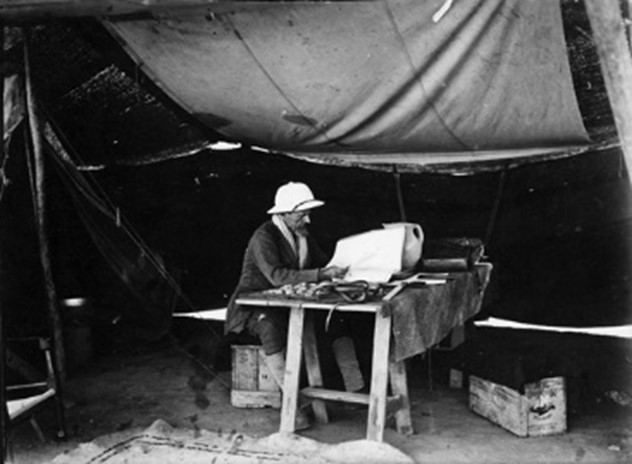
“Careful analysis of these powerful data holds enormous potential for future discoveries in the Near East and beyond,” Casana said.  Archaeologist Poidebard sorting shards ( Bak 1928).

AERIAL ARCHAEOLOGY

Antoine Poidebard- Archeologie.culture.FR (retrieved Internet 2023.)

Jesuit missionary and explorer, Antoine Poidebard (1878-1955) settled in Beirut in 1925. Charged with mapping missions by the French mandatory authorities, he realised the extraordinary potential of aerial reconnaissance for recording archaeological data.

From the shores of the Mediterranean to the skies of the Levant (Middle East)

Provided with logistical support by the French airforce, he clocked up thousands of flying hours, mainly over the desert steppes of Syria, but also along the Mediterranean coast as far as Algeria and Tunisia. A highly talented amateur, Poidebard developed innovative technical processes and used strict procedures, paving the way for aerial archaeology as a scientific method.

Using art and technology for archaeological research

Antoine Poidebard’s archives are conserved in the Oriental Library of Saint Joseph University , which presents some of them in its virtual exhibition. It reveals the surprising conjunction between the rigours of scientific research and the artistic scope of Poidebard’s photographs, combining photography, aeronautics and archaeology. (https://www.usj.edu.lb/search.php?q=antoine%20poidebard) Universite Saint-Joseph de Beyrouth.

“Archives collected in the desert sand” 2016-2017 at the Laténium

In 2016-2017, an exhibition devoted to Antoine Poidebard, called the “Archives collected in the desert sand, from Palmyra to Cartago” was organised by the Laténium (https://latenium.ch/en/press-and-archives/exhibition-archives-old/archives-des-sables-de-palmyre-a-carthage/) (Neuchatel, SUI) to shed light on the outstanding aerial photographs taken during the interwar period by Poidebard in the Near East.

Leaflet | © OpenStreetMap contributors

SCIENTIFIC DIRECTION

Marc-Antoine Kaeser (Laténium)(Switzerland) and Lévon Nordiguian (University of Beirut)


Fr. Antoine Poidebard and the Middle East

05 Sunday Nov 2023

Posted by webbywriter1 in Uncategorized

≈ Comments Off on Fr. Antoine Poidebard and the Middle East

Fr. Antoine Poidebard and the Middle-East.

Courtney Webb

Antoine Poidebard; Lyon, France 1878 to Beirut 1955, (77 years) was a Jesuit priest and member of the Society of Jesus.

He developed the art of aerial photography by flying over Iraq, Syria and Jordan in a biplane in the 20’s and 30’s. His numerous photographs have been used to this day and he was able to discern differences in vegetation to show abandoned Roman forts and roads.

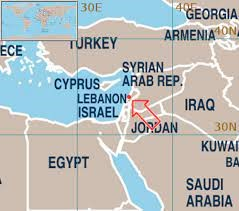
How and why was he there? The Mandate for Syria and Lebanon was established in 1920. Under this mandate, France assumed administrative control of the territories of modern-day Syria and Lebanon. However, the actual implementation of the mandate was met with resistance from local nationalist movements and populations who sought independence.

The mandate had been granted by the League of Nations to France after World War I. The purpose was to establish governments in area previously ruled by the Ottoman Empire.

Later, Syria and Lebanon were both granted independence from France in 1943. Poidebard was financially supported by various institutions to do research, especially in Syria. One of the significant sources of funding for his work was the French government. His archaeological and aerial survey missions were often sponsored by the French Ministry of Foreign Affairs and the French Ministry of National Education. (Retrieved Internet 2023.) He received additional funding from the French Institute of Archaeology in Beirut and the French School of Athens.

 map of the Middle East area

 map of Beirut, Lebanon

The Aircraft

 https://www.youtube.com/watch?v=927r7wHOef4  (video about Caudron G.3’s)

The Caudron G.3 was a French reconnaissance aircraft widely used during World War I. Poidebard flew the Caudron G.3 biplane for his aerial archaeological surveys in the 1920s and 1930s. The Caudron G.3 was a French reconnaissance aircraft widely used during World War I. He learned to fly during the war and then created a way to utilize the aircraft for aerial surveys of archaeological sites in Syria and parts of the Middle East, capturing valuable photographs of historical sites and landscapes from the air. His pioneering work in this area significantly contributed to the understanding of ancient civilizations in the region.

https://www.youtube.com/watch?v=kr4e23CarYY (more videos about this aircraft.)

Aerial photographs of abandoned Roman forts in the Middle East.
Fr. Poidebard examing shards in the desert.

Subscribe

  • Entries (RSS)
  • Comments (RSS)

Archives

  • December 2025
  • November 2025
  • October 2025
  • September 2025
  • August 2025
  • May 2025
  • April 2025
  • March 2025
  • February 2025
  • December 2024
  • November 2024
  • October 2024
  • September 2024
  • August 2024
  • July 2024
  • May 2024
  • April 2024
  • March 2024
  • February 2024
  • January 2024
  • December 2023
  • November 2023
  • October 2023
  • September 2023
  • August 2023
  • July 2023
  • June 2023
  • May 2023
  • April 2023
  • March 2023
  • February 2023
  • January 2023
  • December 2022
  • November 2022
  • October 2022
  • September 2022
  • August 2022
  • July 2022
  • June 2022
  • May 2022
  • April 2022
  • March 2022
  • February 2022
  • January 2022
  • December 2021
  • November 2021
  • October 2021
  • September 2021
  • August 2021
  • July 2021
  • April 2021
  • February 2021
  • January 2021
  • December 2020
  • November 2020
  • October 2020
  • September 2020
  • August 2020
  • July 2020
  • June 2020
  • May 2020
  • April 2020
  • March 2020
  • February 2020
  • January 2020
  • December 2019
  • October 2019
  • September 2019
  • May 2019
  • April 2019
  • March 2019
  • January 2019
  • December 2018
  • November 2018
  • October 2018
  • September 2018
  • August 2018
  • July 2018
  • June 2018
  • May 2018
  • April 2018
  • March 2018
  • February 2018
  • December 2017
  • October 2017
  • September 2017
  • August 2017
  • June 2017
  • May 2017
  • March 2017
  • November 2016
  • October 2016
  • September 2016
  • August 2016
  • June 2016
  • May 2016
  • April 2016
  • March 2016
  • February 2016
  • January 2016
  • November 2015
  • October 2015
  • September 2015
  • August 2015
  • March 2015
  • January 2015
  • November 2014
  • October 2014
  • September 2014

Categories

  • aging, exercise
  • Book Sales: Amazon.com/Kindle Books
  • CALORIES
  • coffee
  • Crime – Fioction
  • cutting
  • dating
  • dementia
  • diet
  • families
  • Fiction
    • detective stories
    • mystery
  • FRIENDSHIP
  • health and aging
  • holidays
  • homelessnes
  • Jobs and the workplace
  • kids
  • lattes
  • marriage
  • money
  • music
  • Native Americans
  • poetry
  • romance
  • signs
  • South Korea
  • stress
  • strokes
  • teenagers
  • Uncategorized

Meta

  • Create account
  • Log in

Blog at WordPress.com.

Privacy & Cookies: This site uses cookies. By continuing to use this website, you agree to their use.
To find out more, including how to control cookies, see here: Cookie Policy
  • Subscribe Subscribed
    • webby1dotnet
    • Join 55 other subscribers
    • Already have a WordPress.com account? Log in now.
    • webby1dotnet
    • Subscribe Subscribed
    • Sign up
    • Log in
    • Report this content
    • View site in Reader
    • Manage subscriptions
    • Collapse this bar
 

Loading Comments...