“American working men and women have much of which to be proud. Our democracy is based on their good sense and commitment to liberty. It was the hard work and skill of working people that turned a vast American wilderness into the world’s most powerful economy.”
“The great safeguard of our liberty is the totality of the constitutional system, with no one part getting the upper hand.”
“Indeed, I believe that the world of the future can be just that — a world of liberty, a world in which human rights are respected in the political and economic spheres alike.”
Strong leaders don’t fear criticism, but weak ones do.
Support free speech before we start looking like our communist neighbors!!!!!!
China’s rise in the world market led the Chinese diaspora in Africa to make contact with relatives in their homeland. Renewed relations created a portal through which African demand for low-price consumers goods could flow.[18] Chinese businessmen in Africa, with contacts in China, brought in skilled industrial engineers and technicians such as mechanics, electricians, carpenters, to build African industry from the ground up.[19]
The 1995 official Go Global declaration and the 2001 Chinese entry into the WTO paved the way for private citizens in China to increasingly connect with, import from, and export to the budding Sino-African markets.
Expansion of military presence (1990 to the present)
Africa does not stand at the center of China’s security strategies, yet the continent has been and remains a major source for China’s commodity stocks. Africa was also seen as an important bid for international legitimacy against the eastern and western blocks. In the 1960s, China contributed to Africa’s military power by assisting and training liberation groups, such as Mugabe‘s ZANU.
The Chinese military presence in Africa has increased since 1990 when China agreed to join in UN peace-keeping responsibilities.[21] In January 2005, 598 Chinese peace keepers were sent to Liberia. Others were sent to Western Sahara as part of Operation MINURSO,[22]Sierra Leone, the Ivory Coast and the DRC.[21] This was a carefully handled and largely symbolic move, as China did not want to appear as a new colonialist power overly interfering in internal affairs.
China currently has military alliances with 6 African states, 4 of which are major oil suppliers: Sudan, Algeria, Nigeria and Egypt.[21] On the whole, however, China’s influence remains limited,[23] especially when compared with Western powers such as France, whose military involvement in the 2004 Ivory Coast conflict and the 2006 Chad conflict was significant. China is particularly unable to compete with the ex-colonial powers in providing military training and educational programs, given the latter’s continuing ties via military academies like Sandhurst in the UK and Saint Cyr in France.[23]
In 2015, despite growing economic interests in Africa, China has not yet settled any military base on the continent. However, with a naval logistics center is planned to be built in Djibouti raises questions about China’s need to set military bases in Africa. China’s increasing reliance on Africa’s resources warrants it to hold a stronger military position.[24]
Effects of the global economic downturn (2007 to the present)
Since 2009, a switch has been noticed in China’s approach to Africa. The new tack has been to underline long-term stability in light of the worldwide economic crisis.[25]
Some major projects get stopped, such as in Angola, where 2/3 of a US$4 billion CIF fund disappeared, it is unclear where this money went.[26][27] Following this, a major Chinese-backed oil refinery project was scrapped by Angolan officials, with unclear reasons, causing problems for Sino-Angolan relations.[27]
At the dawn of the 21st century, while Africa suffered from China’s withdrawal, it is less dependent of external powers to build a self-reliable economy.[28]
The China Africa Research Initiative estimated that there were over 88,371 Chinese workers in Africa in 2022, down from a high of 263,696 in 2015.[29]
≈ Comments Off on First Amendment Rights: right to assemble.
…First Amendment
Congress shall make no law respecting an establishment of religion, or prohibiting the free exercise thereof; or abridging the freedom of speech, or of the press; or the right of the people peaceably to assemble, and to petition the Government for a redress of grievances.
Alarm after FBI arrests US army veteran for ‘conspiracy’ over protest against Ice
Legal experts say charges against Afghanistan war veteran Bajun Mavalwalla II mark an escalation in the Trump administration’s crackdown on first amendment rights. Aaron GlantzTue 2 Sep 2025 06.00 EDTShare: The Guardian
The arrest of a US army veteran who protested against the Trump administration’s immigration crackdown has raised alarms among legal experts and fellow veterans familiar with his service in Afghanistan.
Bajun Mavalwalla II – a former army sergeant who survived a roadside bomb blast on a special operations missionin Afghanistan – was charged in July with “conspiracy to impede or injure officers” after joining a demonstration against federal Immigration and Customs Enforcement (Ice) in Spokane, Washington.
Legal experts say the case marks an escalation in the administration’s attacks on first amendment rights. Afghanistan war veterans who know him say the case against Mavalwalla appears unjust.
“Here’s a guy who held a top secret clearance and was privy to some of the most sensitive information we have, who served in a combat zone,” said Kenneth Koop, a retired colonel who trained the Afghan military and police during Mavalwalla’s deployment. “To see him treated like this really sticks in my craw.”
The 11 June protest against Ice that led to Mavalwalla’s arrest was confrontational, leaving a government van’s windshield smashed and tires slashed, but Mavalwalla was not among the more than two dozen people arrested at the scene. More than a month passed before the FBI arrived at his door on 15 July.
The 35-year-old, who used his GI Bill to earn a degree in sustainable communities fromSonoma State University, was set to move into a 3,000-sq-ft house that day, which he had bought with his girlfriend, a nurse and fellow Afghanistan war veteran, with the help of a loan backed by the Department of Veterans Affairs.
Mavalwalla’s father, a retired US army intelligence officer with three Bronze Stars earned during tours in Iraq and Afghanistan, brought his truck for the occasion. He planned to move his son into a dream home in a bucolic, southern section of Spokane that was large enough to accommodate their blended family (Mavalwalla has one child; his girlfriend, Katelyn Gaston, has three) and solidify the couple’s life together.
But at 6am the FBI knocked on Mavalwalla’s door and they arrested him. Cell phone video shot by Mavalwalla’s father shows the veteran – tall, fit, with wire-rimmed glasses, tight ponytail and trim goatee – smiling in apparent disbelief, his hands shackled behind his back.
“This is not how I planned to spend my moving day,” Mavalwalla says, as agents search his pockets and force him into a black pickup truck. “I’m a military veteran. I’m an American citizen.”
At 3pm, Mavalwalla, who receives disability compensation for post traumatic stress disorder connected to his service in Afghanistan, appeared in federal court along with eight other people indicted in connection with a protest against an Ice transport that occurred a month earlier.
While the indictment alleges other protesters struck federal officers and let the air out of the tires of an Ice transport, Mavalwalla was not charged with obstruction or assault. Instead, he was charged with “conspiracy to impede or injure officers”.
According to the indictment, Mavalwalla and his co-defendants “physically blocked the drive-way of the federal facility and/or physically pushed against officers despite orders to disperse and efforts to remove them from the property”.
Mavalwalla, who has no criminal record, pleaded not guilty.
The conspiracy count carries a maximum penalty of six years in prison, a $250,000 fine and three years of supervised release. He was released on his own recognizance while awaiting trial, with a judge even giving him permission to travel to Disneyland for a previously planned family vacation.
The US attorney’s office in Spokane, which brought the charges, declined to comment, citing an ongoing investigation.
The indictment was handed down two days after career prosecutor Richard Barker, the acting US attorney for eastern Washington state, resigned. In a social post, Barker called his exit “a very difficult decision”.
“I am grateful that I never had to sign an indictment or file a brief that I didn’t believe in,” he wrote.
The current acting US attorney, nominated for the permanent post by Donald Trump, is Pete Serrano, a former litigator for the Silent Majority Foundation, a conservative advocacy group. In February, Serrano filed an amicus brief in support of Trump’s executive order to end birthright citizenship, a position at odds with the 14th amendment. He has no prosecutorial experience and has described the January 6 US Capitol rioters as “political prisoners”.
Patty Murray, a Democratic senator from Washington state, has pledged to block his confirmation.
Legal experts say the conspiracy charges against Mavalwalla underscore the lengths the Trump administration will go to quash protests against Ice, giving the immigration agency a free hand as it steps up raids, adds agents and seeks to achieve the president’s goal of 3,000 deportations per day.
So far, the Trump administration has primarily charged demonstrators for assault and obstruction, acts that typically involve a victim and an assailant. But a federal conspiracy charge is a crime of intent. In this case, prosecutors would just have to prove that defendants agreed in concert to impede or injure an officer.
The charges against Mavalwalla sent shockwaves through a tight community of veterans with connections forged in Afghanistan that intensified after the bungled August 2021 US withdrawal. The fall of Kabul to the Taliban brought them together again to evacuate Afghans who worked alongside the US military.
After his arrest, Mavalwalla’s commanding officer, Col Charles Hancock, who is retired, wrote on Facebook that he knew the trained crypto-linguist to be “honest, direct, polite and very trustworthy” and was “deeply concerned about the current state of affairs in our country”.
Koop, the retired colonel, said Mavalwalla put the diplomatic connections he gained due to his security clearance at the disposal of Koop’s translator, who escaped and otherwise might have been murdered by the Taliban. “It was no surprise to me that concern for the individual, human rights and safety would be right up Bajun’s portfolio and mindset,” Koop said.
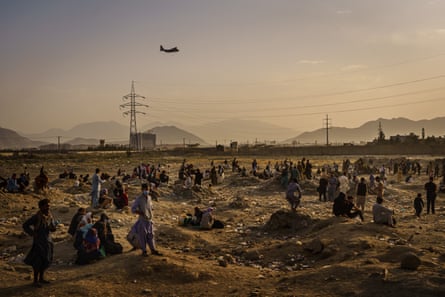
A military transport plane launches off while Afghans who cannot get into the airport to evacuate, watch and wonder while stranded outside, in Kabul, Afghanistan, on 23 August 2021. Photograph: Marcus Yam/Los Angeles Times/Getty Images
Mavalwalla sprung into action, locating safe houses for 20 members of the former custodian’s extended family and at least a dozen other Afghan civilians whose family members collaborated with the US military, she said. He helped them acquire travel documents, arranged for safe transport over land to Pakistan and raised $130,000 to pay expenses, including visa applications and flights there to Brazil and eventually to the United States.
“It was hard,” Piper said, but Mavalwalla was patient.
In text messages, he urged Piper to be sure to take care of herself and her family. “It does no good for us to neglect those right in front of us,” he wrote on 25 September 2021, a month after the Taliban takeover.
“You cannot save the world,” he added. “It’s good to try though.”
Mavalwalla was one of hundreds of people to respond to a 11 June social media post from the former president of the Spokane city council that encouraged protesters to block an Ice transport they believed would carry two Venezuelan immigrants who were in the country legally, petitioning for asylum when they were detained.
“I am going to sit in front of the bus,” Ben Stuckart, the former city council president, wrote. “Feel free to join me.”
In interviews, former prosecutors said the conspiracy statute was broad and afforded the Trump administration potentially sweeping powers.
“Federal conspiracy charges are a wondrous thing,” said Bruce Antkowiak, a former federal prosecutor who teaches at Saint Vincent College in Pennsylvania. “It is a vast net which you can use to catch a bunch of people.”
Under this law, prosecutors won’t have to prove that Mavalwalla blocked the bus or attacked agents, Antkowiak said. “The major issue in a conspiracy case is intent,” he said. “You have to prove an agreement. You don’t have to prove that people sat down together and made a pledge. You don’t even have to write up an agreement they have verbally, but you have to prove that these people agreed to act in concert,” he said.
Because of the law’s sweeping power, prosecutors typically use discretion, experts said.
“It seems like what we have here is an issue of selective prosecution,” Robert Chang, a law professor at the University of California, Irvine, said that will lead to a “chilling effect on free speech under the first amendment”.
Antkowiak said he expected the justice department to bring conspiracy charges more frequently in the months ahead, given the Trump administration’s desire for Ice agents to pursue an agenda of rapid deportations unhindered.
Jennifer Chacón, a Stanford University law professor who studies the intersection of immigration and criminal law, said she would not be surprised if Ice increased monitoring social media to bring more cases like the one against Mavalwalla.
“You could view this as an attempt to send a message to everyone who feels a sense of justice and moral outrage over Ice raids – you could face prosecution, too,” she said.
Mavalwalla’s mother, US army veteran Ellyn Mavalwalla, said her son did not know Stuckart, the former city councilman whose social media post sparked the demonstration, and only met him in jail on 15 July, after both were arrested on federal charges by the FBI.
His father, retired intelligence officer Bajun Ray Mavalwalla, said he believed his son had been racially profiled – that in reviewing footage from the demonstration, federal authorities had fixated on the demonstrator “with a funny name”.
He said he worried the United States was being “taken over by fascists”, but also that the promise of America that drew his family here generations ago would endure.
“My father left India on the deck of a boat, at 19 years old,” the elder Mavalwallasaid. “He floated for six days across the Arabian Sea to Kuwait. He nearly died when he arrived. Then an American family sponsored him to come to the US.”
Gandhi’s legacy
In addition to military service, a commitment to peaceful protest has been at the heart of the Mavalwalla family for generations.
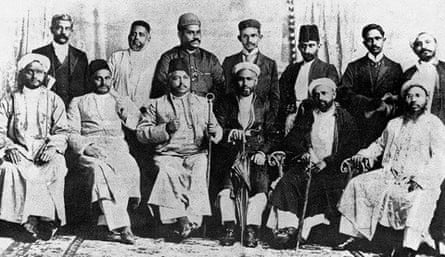
Rustomjee and Gandhi. Photograph: undefined/Courtesy Mavalwalla Family
Mavalwalla II’s great-great, grand-uncle, Parsee Rustomjee worked withGandhi in South Africa and supported the Indian independence leader when he launched his legendary, non-violent revolution against British imperialism.
The two families were close – according to the family, Gandhi was godfather to Mavalwalla’s great-grandmother – “and Bajun grew up with stories,” his mother said, with social justice at the center.
After Gandhi was assassinated in 1948, his burial shroud was distributed among his family’s closest confidants, including members of Mavalwalla’s family, and is now held by Mavalwalla’s mother.
Three days after the protest, his mother texted him: “Channel your inner Gandhi.”
Krause and Miller were among the more than 300 students who gathered to protest the expansion of the Cambodian campaign, which President Richard Nixon had announced in an April 30 television address. Scheuer and Schroeder were in the crowd of several hundred others who had been observing the proceedings more than 300 feet (91 m) from the firing line; like most observers, they watched the protest during a break between their classes.[11][12]
We need to remember what the National Guard are capable of. Those are real guns with real bullets.
The answer is, in general yes. However, recently research indicates that although the hormone estrogen does play a part in women’s longer lives; factors like drinking and smoking are the most likely culprits to men’s shorter life spans. As the younger generation turns away from smoking, longevity increases.
Do Men Age Faster Than Women?
Men Age Faster Than Women, but the Younger Generation Is Closing the Gap
Summary: Researchers shed light on why the life expectancy and aging gap is narrowing between men and women.
Source: University of Jyväskylä
In the Western world, life expectancy rapidly increased in the twentieth century, but women still have longer life expectancy than men. In Finland, women live on average five years longer than men.
The gap between the sexes was greatest in the 1970s, when life expectancy at birth was almost 10 years higher for women than for men. However, in recent decades, this gap has gradually narrowed.
The difference between the sexes can also be seen in biological aging, as revealed by a study recently published in The Journals of Gerontology: Series A.
The study investigated whether there are differences in biological aging between men and women and whether the potential differences can be explained by lifestyle-related factors. These differences were investigated in young and older adults.
Several epigenetic clocks were used as measures of biological aging. Epigenetic clocks enable studying lifespan-related factors during an individual’s lifetime. They provide an estimate for biological age in years using DNA methylation levels determined from a blood sample.
“We found that men are biologically older than women of the same chronological age, and the difference is considerably larger in older participants,” says Anna Kankaanpää, doctoral researcher at the Gerontology Research Center and the Faculty of Sport and Health Sciences.
More frequent smoking among men explained the sex gap in aging in older but not in young adult twins. In addition, men’s larger body size explained a small part of the sex gap in both age groups.
Several epigenetic clocks were used as measures of biological aging. Image is in the public domain
“In our study, we also used a quite rare study design and compared aging pace among opposite-sex twin pairs. A similar difference was also observed among these pairs of twins. The male sibling was about one year biologically older than his female co-twin.
“These pairs have grown in the same environment and share half of their genes. The difference may be explained, for example, by sex differences in genetic factors and the beneficial effects of the female sex hormone estrogen on health,” Kankaanpää says.
The results help to understand lifestyle behaviors and sex differences related to biological aging and life expectancy. The results suggest that the decline in smoking among men partly explains why the sex gap in life expectancy has narrowed in recent decades.
Abstract
Do Epigenetic Clocks Provide Explanations for Sex Differences in Life Span? A Cross-Sectional Twin Study
Background
The sex gap in life expectancy has been narrowing in Finland over the past 4–5 decades; however, on average, women still live longer than men. Epigenetic clocks are markers for biological aging which predict life span. In this study, we examined the mediating role of lifestyle factors on the association between sex and biological aging in younger and older adults.
Results
In comparison to women, men were biologically older and, in general, they had unhealthier life habits. The effect of sex on biological aging was partly mediated by body mass index and, in older twins, by smoking. Sex was directly associated with biological aging and the association was stronger in older twins.
Conclusions
Previously reported sex differences in life span are also evident in biological aging. Declining smoking prevalence among men is a plausible explanation for the narrowing of the difference in life expectancy between the sexes. Data generated by the epigenetic clocks may help in estimating the effects of lifestyle and environmental factors on aging and in predicting aging in future generations.

 Show map of OhioShow map of the United StatesShow all

 webby1dotnet

