Do Hiring Quotas Exist? Yes, now more than ever.

Archives | 1990 New York Times

Hiring Quotas Exist, but Employers Won’t Tell

, Page 00020The New York Times Archives

To the Editor:

”Enough Haggling on Civil Rights” (editorial, July 17) argues that it is a red herring to claim that the civil rights bill of 1990 would result in quotas, for neither President Bush nor business lobbyists ”produce any evidence that the 1971 ruling resulted in job quotas.” You have taken employers’ fear of self-incrimination in revealing their use of quotas for the absence of evidence that they have been forced to use them.

It is an open secret among personnel professionals that race-conscious hiring has become the rule, not the exception, since the 1971 Griggs ruling you refer to, and moreover that such practices are routinely camouflaged by statistical legerdemain or newspeak about what constitutes merit hiring. While employers often resort to quotas or other race-conscious hiring procedures to avoid litigation under Griggs, they must deny such practices publicly to avoid reverse discrimination suits. We need not wonder why employers are not coming forth to document the legacy of Griggs.

One of America’s best-kept open secrets is that the Employment Service of the Department of Labor has unabashedly promulgated quotas. In 1981 the service recommended that state employment agencies adopt a race-conscious way of recomputing test scores on the Employment Service aptitude test battery to avoid adverse impact when referring job applicants to employers.

Under the recommended procedure, called race-norming, each candidate’s score is reported not in relation to those of all other candidates, but only in relation to the scores of applicants of the same racial group. Blacks are compared only with other blacks, Hispanics only with other Hispanics and ”others” with all but blacks and Hispanics. Race-norming does the work of quotas by, in effect, giving bonus points to all members of groups that tend to score lower than others, offsetting average differences in scores among groups.

The score adjustments are not trivial. An unadjusted score that places a job applicant at the 15th percentile among whites would, after race-norming, typically place a black near the white 50th percentile. Likewise, unadjusted scores at the white 50th percentile would, after race-norming, typically place a black near the 85th percentile for white job applicants.

The Employment Service recommended this system of racial quotas, despite showing that its aptitude tests meet the Griggs job-relatedness criterion, simply to avoid adverse impact, which is the trigger for litigation established by Griggs and its progeny. By 1986, state employment agencies in 40 states were using the United States Employment Service system to some extent.

This system of race-conscious score adjustments has been subjected to scientific scrutiny and some public debate since 1986, when Assistant Attorney General William Bradford Reynolds threatened to sue the Labor Department for reverse discrimination. Whatever the system’s eventual fate may be, its use by 40 states in the last decade belies the claim that Griggs did not lead to quotas.


LINDA S. GOTTFREDSON

Newark, Del., July 18, 1990

The writer is a professor of education at the University of Delaware.


Serious About Serials: The Power of Serial Books to Encourage Young Readers


What is it about serial books that keep kids coming back for more? The Harry Potter Series, the Rick Riordan – Lighting Thief series, and Nancy Drew among others have entranced young readers for generations and made books disappear off shelves.

So, what is it then? Readers young and old get invested in the characters in the book. Harry, Nancy and Percy Jackson become known to us and become like old friends. Just like our favorite soaps or shows on TV, we become a part of their family and their lives.

Additionally, with kids, they look upon their paper characters as figures to copy and emulate. For instance, I always loved Nancy’s shoes and convertible. Wow! I wanted one. I also wanted to be just like Nancy when I grew up. That’s some role model!

Additionally, the books are usually grouped together on shelves, their covers look very much the same and are easily recognizable. For a ten-year-old who is overwhelmed by the volume and complexity of the ordinary library, this is an important selling point. It is not important to remember the exact title or author. Just, that wizard kid with the glasses will do.

Serials have actually been around for much longer than I had realized. I did a little research on Millie Wirt Benson, who started writing the Nancy Drew series in 1930. Edward Stratemeyer, the editor, created the Hardy Boys books earlier. The series was such a hit, he decided to create a female version for his girl readers. He hired Benson as his ghostwriter.

Stratemeyer was preceded in the genre by Horatio Algers whose kid books were popular before the turn of the twentieth century. So, serial readers have been around for some time.  They are excellent ways for kids to get ‘hooked’ on reading. After reading as many of the Drew books as possible, I graduated to Jane Eyre and English romances.

The Good and the Bad

While series are undoubtably a wonderful source of enticing literature for kids, there have been some disturbing trends in the modern genre and fiction books in general. In doing my bit of research into the creation of the Drew series, I was interested to note that Stratemeyer had guidelines for all his juvenile fiction writers. Those were no extreme violence, death or sexuality beyond a little cheek peck. Later, some of these books were deemed to be hopelessly old-fashioned and had to be ‘modernized’. Geeze, save us from old-fashionedness!

Book sales have always been important, even in Stratemeyer’s day. However, there seems to be a growing trend in all fiction markets to keep pushing the limits of ‘acceptable’ particularly in the uses of graphic violence and graphic sexuality. I love a good mystery and have read a lot of them. However, mystery/thriller writers like Steven Berry and Patricia Cornwall have pushed the limits so far with their scenes of violence and sick brutality, that I won’t read their books anymore. In my list of popular series for Young Adults, The City of Bones series which I read, has some scenes of sick violence so great that I wish I had never read them. One scene with a baby keeps playing in my head. Uck!

Now it is difficult to draw a straight line from violent films, literature and games to violence in the streets. All parents wish they had a sure-fire litmus test they could use on these medias to tell which ones are harmful. Unfortunately, there is no such test. As parents and teachers, we will be forced to use the old noggin and common sense to help direct kids to quality reading.

For example, Harry Potter, who I have mentioned several times, is not used as a literature book in school, although it is in most school and public libraries. The reason: Harry is a wizard and his world is filled up with magic, violence and death. These themes are unacceptable to many parents, so schools just avoid the fight and don’t teach with those books. However, The Giver, which is commonly used, is also about birth and death, just in not such a theatrical fashion.

I will list the most popular series books sold and list them by millions of copies sold. I will also list which ones feature violence and death and let you make your own decisions about them.

The Book Series                                                                                    Millions of Books sold

Harry Potter – Rowling                                                                        450 Million (magic, violence and death)

Percy Jackson – Riordan                                                                      400 (some violence)

Sweet Valley High- Pascal                                                                   250

Babysitters Club – Martin                                                                    172

The New Girl – Puckett                                                                        80

The Hardy Boys – Dixon                                                                     70

Nancy Drew – Keene                                                                           70

Hunger Games – Collins                                                                      65 (violence, death.)

City of Bones – Clare                                                                            36 (graphic violence, death)

Eragon – Paolini                                                                                    33 (graphic violence )

Artemis Fowl – Colfer                                                                          21- (some violence)

Redwall – Jacques                                                                                20 – (violence)

Divergent – Roth                                                                                  20 (some violence)

Golden Compass – Pullman                                                               15 million


Refer to: www.commonsensemedia.org and http://www.shmoop.com for further reviews.


Courtney Webb

Telephone Call – Carolyn Keene. Calling – Miss Keene

The Clues to the Real Carolyn Keene – writer of the Nancy Drew mysteries. …..

‘The wind howled through the dark night. Nancy bent over with the light of her torch to examine the dark spot on the wood floor. Blood? She dipped in the tip of her finger and put it to her nose. Yup. It was the stuff.

Further away she shone her light on the floor and could see remains of a shattered vase. It looked to be expensive like everything else in this Arts and Crafts style house on the edge of Pasadena. She shone the light around and could detect footprints leading away.

Cautiously, making as little noise as possible, she followed the prints through the swinging wood door. It led to a large dining room. Nancy advanced softly and could just make out the slumped form next to the oak table. He looked like he had been trying to pull himself up. The elderly gentleman was lying almost face down with his head to the side and both hands clinched. A large spot on the back of his head showed through his white hair. Something white peeked through fingers of one craggy old hand.

Knowing full well she shouldn’t do this, Nancy gently tugged the paper out of his hand. She touched him at the neck knowing there would be no pulse. There wasn’t. She shone her torch on the paper. The Ghost….was scrawled on the paper. There was a bang in the background, Nancy jumped. The murderer could still be in the house.

Catlike, she retraced her path back to the front door. She stepped gingerly out turning off the torch. She peered around the front driveway and bushes. No one. Her heart in her mouth, she grabbed the car keys from her purse and made a run for her car.

She yanked open the car door, slammed it shut and banged down the locks. The key in the ignition, she did a rapid three-point turn and peeled rubber until she was far down the hill and on the way home. She pulled into a coffee shop and called the police. She knew her buddy, Sergeant Fred or Freddie wouldn’t be working this late so, she made the report to the desk cop and left her name and number. Yikes! What an evening. Jeepers.’


Mildred Wirt Benson leaned over her heavy black typewriter and peered at her copy. Was this going to do it? This character was something new and different. A Sherlock Holmes type but, American and importantly, female. Wow! How were people going to react to this character? She wasn’t typical female and broke so many rules.

This Nancy was, hum, Mildred had to think. Nancy was strong-minded, strong-willed, independent. She was curious, action-oriented, loved to get into trouble, mind other people’s business and in general make a nuisance of herself. She was the bane to her lawyer father, who loved her to bits, and her somewhat scattered boyfriend, Ned.

Plus, Nancy was continually getting into and out of scrapes with and without the help of friends and family, yet, by the hair of her chinny-chin-chin, managed to pull the rabbit out of the hat at the last moment.

She pulled the last sheet out of the typewriter and placed in on the pile with the others. Hopefully, her editor would like it, approve of it and most importantly, pay her for it! A smile of satisfaction played on Mildred’s lips. Nancy was all the things she could never be. Nancy would probably just march right into Stratemeyer’s office and….


The character, Nancy Drew, was conceived by Edward Stratemeyer, founder of the Stratemeyer Syndicate. Stratemeyer had created the Hardy Boys series in 1926, which had been such a success that he decided on a similar series for girls, featuring an amateur girl detective as the heroine. He was aware that the Hardy Boys books were popular with girl readers and wished to capitalize on girls’ interest in mysteries by offering a strong female heroine.

Stratemeyer initially pitched the new series to Hardy Boys publishers Grosset & Dunlap as the “Stella Strong Stories”, adding that “they might also be called ‘Diana Drew Stories’, ‘Diana Dare Stories’, ‘Nan Nelson Stories’, ‘Nan Drew Stories’, or ‘Helen Hale Stories’.” Editors at Grosset & Dunlap preferred “Nan Drew” of these options, but decided to lengthen “Nan” to “Nancy”. Stratemeyer accordingly began writing plot outlines and hired  Mildred Wirt, later Mildred Wirt Benson, to ghostwrite the first volumes in the series under the pseudonym Carolyn Keene.

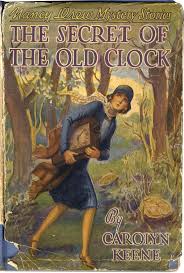
The first four titles were published in 1930 and were an immediate success. The books popularity can be seen in a letter that Laura Harris, a Grosset and Dunlap editor, wrote to the Syndicate in 1931: “can you let us have the manuscript as soon as possible, and no later than July 10? There will only be three or four titles brought out then and the Nancy Drew is one of the most important.”secret of the old clock

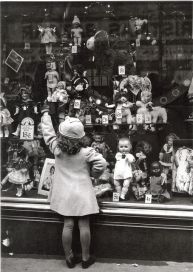
The 6,000 copies that Macy’s ordered for the 1933 Christmas season sold out within days. In 4/1934 Fortune Magazine featured the Syndicate in a cover story and singled Nancy Drew out for particular attention: “Nancy is the greatest phenomenon among all the fifty-centers. She is a best seller. How she crashed a Valhalla that had been rigidly restricted to the male of her species is a mystery even to her publishers.”little girl at Macys

During the height of the greatest depression that the US has ever experienced, the appearance of these books and their popularity was astounding. Maybe it was the times. Maybe people need to feel that they had some kind of personal control.


The Real Carolyn Keenemildred wirt benson


Mildred Benson was born Mildred Augustine in Ladora, Iowa to Lillian and Dr. J. L. Augustine. Benson earned her degree in English from the University of Iowa in 1925 in a short three years. She later returned to the University and in 1927, became the first student there to earn a master’s degree in journalism. She was married to Asa Wirt, an Associated Press writer. The couple had a daughter, Peggy Wirt, in 1936. After Wirt’s death in 1947, she married George A. Benson, editor of the Toledo Blade.

Benson worked for 58 years as a journalist, and author of children’s books. She died in 2002 at the age of 96. Benson was a great adventurer, making numerous trips to Central America, traversing the jungle in a Jeep, canoeing down rivers, visiting Mayan sites, flying airplanes and witnessing archaeological excavations.

Nancy Drew

While she wrote scores of books under her own and many other names, Benson is perhaps best known as one of 28 individuals who helped produce the Nancy Drew books.

Published book rights for the Nancy Drew series were then owned by the Stratemeyer Syndicate and are now by Simon & Schuster. As with all syndicate ghostwriters, Benson was paid a flat fee of $125 to $250 for each Stratemeyer-outlined text, the equivalent of three months’ pay for a newspaper reporter at that time. At Edward Stratemeyer’s death in 1930, all Syndicate ghostwriters, including Benson, were sent royalties from their books.

By contract, Benson signed away all rights to her texts and any claim to the pen name, Carolyn Keene. She was, however, permitted to reveal that she wrote for the Syndicate.

Stratemeyer provided Benson with index card thumbnail sketches. However, she was the one who created Nancy’s spunky, plucky personality, and her daring, adventurous spirit. Benson took the plots supplied by the Syndicate and created a character that is still loved today. The Syndicate published the books using the pseudonym, Carolyn Keene. Later, most of the Nancy Drew stories that Benson wrote, were re-written by Edna Stratemeyer Squier and, Harriet Stratemeyer Adams after Stratemeyer’s death.

Other ghostwriters who used this name to write Nancy Drew mysteries included Leslie McFarlane, James Duncan Lawrence, Walter Karig, Nancy Axelrad, Patricia Doll, Charles S. Strong, Alma Sasse, Wilhelmina Rankin, George Waller Jr., Margaret Scherf, and Susan Wittig Albert. To-date, over 80 million copies of the Nancy Drew series have been sold and the books have been translated into 45 languages.

However, Benson herself went on to write even more books. She created The Dana Girls series under the name, again, of Carolyn Keene. Also, the Penny Parker and Dan Carter, Cub Scout series. She was a long-time journalist for her husband’s paper, The Toledo Blade and covered many topics to include the crime beat.


Mildred Wirt Benson captured the essence of the American spirit in the form of a sixteen-year-old girl. Nancy Drew was smart, curious, resourceful, nosey and helpful to others. She used the resources at her disposal to help others in need. She was the epitome of American can-do attitude and at a nexus point in American history, helped to redefine women’s roles. Nancy became a model for girls who would become women themselves one day, of who and what they wished to be. For myself, I always wanted to be Nancy Drew when I grew up. I really loved those shoes!


The end.

nancy drew

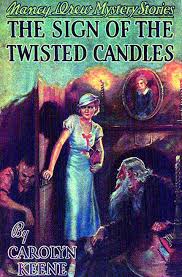
twisted candleReferences


Books at Iowa: The Ghost of Nancy Drew – Iowa Digital Librarydigital.lib.uiowa.edu/bai/lapin.htm

For Indeed it was He, Author unknown, 1934.  Fortune Magazine.

Project Gutenberg project. Author unknown. 2018. Nancy Drew. http://www.self.gutenberg.org/articles/nancy_drew

Webb, C.  Nancy Investigates – 2015

Wikipedia. 2018. Author unknown. Mildred Wirt Benson. https://en.wikipedia.org/wiki/Mildred_Benson

Wikipedia. 2018. Author unknown. Edward Stratemeyer.https://en.wikipedia.org/wiki/Edward_Stratemeye

Micromanaging Makes People Quit!


  • Published on July 5, 2018

Brigette Hyacinth

Trust is the foundation of any successful relationship, whether professionally or personally and when it’s broken, it is extremely hard to repair. I had a supervisor if I was over one minute on my lunch time, she would send an email to remind me of my lunch hours, even though most of the time I never took my full lunch hour. I couldn’t even send an email without her approving it first. She was so inflexible that it was overbearing. I couldn’t trust her. When employees feel they can’t trust their boss, they feel unsafe, like no one has their back, and then spend more energy on survival than performing at their job.

The corporate world is littered with such micromanagers. Sadly many organizations prefer these managers because they seem to be on top of, and in control of everything. In the short term, they may produce results but in the long run they leave a trail of destruction in their path.

“It doesn’t make sense to hire smart people and then tell them what to to. We hire smart people so they can tell us what to do.” ― Steve Jobs

5 Damaging Effects of Micromanagement

1.Decreased Productivity – When a manager is constantly looking over their employees’ shoulders, it can lead to a lot of second-guessing and paranoia, and ultimately leads to dependent employees. Additionally, such managers spends a lot of time giving input and tweaking employee workflows, which can drastically slow down employee response time.

  1. Reduced Innovation – When employees feel like their ideas are invalid or live in constant fear of criticism, it’s eventually going to take a toll on creativity. In cultures where risk-taking is punished, employees will not dare to take the initiative. Why think outside the box when your manager is only going to shoot down your ideas and tell you to do it their way?
  2. Lower Morale – Employees want the feeling of autonomy. If employees cannot make decisions at all without their managers input, they will feel suffocated. Employees that are constantly made to feel they can’t do anything right may try harder for a while, but will eventually stop trying at all. The effects of this will be evident in falling employee engagement levels.
  3. High Staff Turnover – Most people don’t take well to being micromanaged. When talented employees are micromanaged, they often do one thing; quit. No one likes to come to work every day and feel they are walking into a penitentiary with their every movement being monitored. “Please Micromanage Me” Said No Employee ever. I have never seen a happy staff under micromanagement.
  4. Loss of Trust – Micromanagement will eventually lead to a massive breakdown of trust. It demotivates and demoralizes employees. Your staff will no longer see you as a manager, but a oppressor whose only job is to make their working experience miserable.

Micromanagement is a complete waste of everybody’s time. It sucks the life out of employees, fosters anxiety and creates a high stress work environment.

A manager’s job is to provide guidance and support. It’s facilitating a healthy environment where employees can perform at their best. Always be quick to recognize, appreciate and reward employees efforts. Micromanagement breeds resentment and disloyalty. If you hired someone, it means you believe they are capable of doing the job, then trust them to get it done. A high level of trust between managers and employees defines the best workplaces and drives overall company performance.

Micromanaging is the opposite of empowerment and it creates toxic work environments. It chokes the growth of the employee and the organization and fosters mediocrity. When you empower employees, you promote vested interest in the company. Empowered employees are more confident, more willing to go the extra mile for employers, and more willing do whatever it takes to care for customers. The best ideas and advancements are a result of empowering your team.

All in all, keeping great talent really can mean the difference between a business succeeding or failing. In this volatile global marketplace, happy loyal employees are your biggest competitive advantage. If you want performance at scale: Select the right people, provide them with the proper training, tools and support, and then give them room to get the job done!

…………

Junk Yard Dog


“Why can’t we, Mom? Angie just got one. A little white one. He’s really cute.”

Sue paused wiping her hands on a dish towel. She stared at her six-year-old daughter. Scoot, as she was nick-named had silky blond hair, cut in a short bob. She was tall for her age and stared up at her mother with large, luminous green eyes. In common parlance, Scoot was adorable.

It was difficult to say no to her. For anything.

“Scoot, we’ve talked about this before.”

“But, Mom….”

“Scoot, remember,” Sue turned and started unloading the dishwasher, “we’re saving for a house. A house with a yard. Then we can have a dog.”

Scoot looked disappointed and walked away, head down.


Eight months later, Sue and Scoot were moving into their first house. A house with a front yard, back yard and a fence.

Sue stared with satisfaction out at the yard. Not big really, but a little landscaping, nice, and joy of joys, a real slump-stone fence on each side, about five feet tall. Plus, there were large wooden gates with latches on each side. She sighed and slumped down on a green metal yard chair. She had ordered a set to go with the new glass-topped table. They would be able to have real barbeques out here. Right on! She smiled to herself. Patience is its own reward.


The dog discussion was back in full force. Sue was reminded frequently of her promise. Her ex-husband, Billy Bob, started to appear at the new house and join in the discussion.

“Don’t want no little, yappy dogs. Hate them things. Just want to drop kick one a ‘em across the goal post of life.”

Sue rolled her eyes.

“Need a real dog, hunting dog, dog ‘wit bones on ‘em.”

“Yah, Billy, and who exactly is going to be the one to take care of this here hunting dog? Ah, I know, me. No. No big dogs. I’m the one who’ll end up picking up the dog poop, so, the less, the better.”

“Ha,” Billy Bob replied. “Yappy dogs. Bah.”


For weeks, Sue searched the internet for deals on dogs. There weren’t any.

“Golly, two hundred fifty, four hundred dollars for a puppy. Geeze, what are these people thinking?” She sighed and kept looking. This was getting discouraging.


One day Sue and Scoot got home from school. Billy Bob’s old white pickup truck was parked in front of the house. He had taken to letting himself into the backyard. Sue didn’t really mind but wondered what was up. Through the living room glass slider, she could see him sitting out at the backyard table smoking a cigar. Something was running around in the yard.

What in the world? Sue opened the slider and heard barking. A large, brown dog barked and ran toward her. She darted back behind the slider. Billy Bob laughed.

“He won’t hurt nothing. He’s just a big puppy. Razor, come here boy.” The dog ran toward him and sat. Billy patted his head. “See, just a big baby. Come on out here.”

Sue approached cautiously and sat. The dog approached her, tail wagging. He licked her hand. Razor was a large, brown, short-haired something. A mix of boxer and who knew. He wasn’t full grown yet, but had big feet and was all wiry muscle, probably 75 pounds. Definitely not a little, yappy dog. A big yappy dog.

“Well, he seems friendly,” she ventured, cautiously. “But where did he come from?”

“He was from one of the guys at the cigar shop,” Billy took a puff and blew out smoke.

She frowned.

He leaned forward and whispered, “They were going to have to put him down.”

Billy nodded and puffed on his cigar again, smiling. Scoot came out and started to oh and ah over the dog. Razor wagged his tail more and began to run in happy circles.

Sue sat and contemplated, A lot bigger that I wanted of course, but he seems friendly enough, so…. She left Scoot with her dad and went to the pet store to get pet food.

#


The next few weeks proved to be more eventful than Sue had expected. Razor ate a lot of food, left massive poops and started to dig up the backyard. Sue got a shovel to pooper scoop and even Billy Bob helped with some of the cleanup. Problems started when Scoot let Razor in the house.

Sue discovered this when she found her best camera on the floor of the living room. It had been chewed to bits. The bite marks went through both the leather case and into the metal. She picked up the camera and looked at it with amazement. Incredible.

The digging in the back yard continued as Razor systematically destroyed all the landscaping. Sue shook her head. Both house cats were hiding under her bed and would only come out to eat and use the litter box. Sue kept assuring them that the dog was just a puppy. Neither were buying it.

The piece de resistance came about the second month of dog ownership. The next-door neighbors, Bill and Joan Barnett were ‘house proud’ as some would say. A retired couple, their house and their yard were their castle.

Although Sue had been over several times for coffee, the pair had never invited her into the sancto-sanctorum, the backyard pool. Sue tried to have no hard feelings over this. Instead, she choose to not complain and maintain good neighbor relations. It had not been a good week, dog-wise. Razor had gotten into Sue’s closet and managed to find not one, but two pairs of new leather shoes. He chewed up one shoe of each pair. Then, somehow, who knew how, he got out the gate and started to bark at the mailman and chase him down the block. The man was terrified, and Sue was still not sure there wasn’t going to be a formal complaint. Good God, what next?

What next came the very next week with an ominous knock on the front door. Sue was home alone working in her office. Hearing the knock, she went and peeked through the spy hole. It was her next-door neighbor, Bill. This was not a good sign. He never came over. She opened the door cautiously.

“Sue, you got a new dog?” Kind of a question, of course, he already knew the answer.

“Well, yes, Bill, my ex brought him over for Scoot….”

“Sue, that dog crawled over the fence and got into my back yard and started tearing stuff up.”

“I, I, ah…” Sue stuttered. He got over the fence? Unbelievable, it’s five feet high!

“Sue, here’s the thing,” Bill peered at her with a maniacal gleam in his eye. Bill was an old union guy retired from the local brewery. “That dog gets into my yard one more time, I’m going to shoot him. Then I will drag his cold, dead carcass over here and leave him on your front yard.”

She stared at Bill, open-mouthed.

“Ya get me, Sue?”

She nodded dumbly.

“Good, I am so glad we understand each other.”

With that, Bill turned on his heel and stomped back home.

Sue closed the door softly and went back to her office, slumped in her chair, staring into space.

#


“Billy, it’s Sue.”

“Yeah, Sue girl. What’s up?”

“The dog has to go, Billy.”

“Go, go where? Where should he go?”

“Don’t know, don’t care. You brought him here, you take him back.”

“But, but, I told you what was going to happen to him….”

“Don’t give me any more information, Billy, come and get the dog.”

#

“But where did Razor go Mom?” Scoot looked at her mom with beseeching eyes.

“Your dad had to take him back Scoot, where he got him. I’m sorry, the people wanted him back,” Sue lied. Scoot looked like she was going to tear up. “But,” Sue added quickly, “look at this.” She opened her computer screen to a site and pointed to a picture. It was a picture of a little, black puppy with curly hair.

“Look Scoot, he is a little older now, but not much and the lady is willing to sell him to us. A little cocker spaniel. Just our kind of dog.”

“Really?” Scoot looked open-mouthed at the picture. “When do we get him?”

“We go pick him up this weekend. And I will let you pick out a name. What do you think it will be?”

Scoot got serious and thought hard.

“Would it be okay if we called him Razor too?”

Sue laughed with relief.

“If that would make you happy, we’ll call him whatever you want.”

The two sat and looked at more pictures of prize cockers. She marked the calendar in big letters,

Pick up Razor!!!!!!


The end.


cew


Muffin Squirrel


I made a batch of blueberry muffins. The fat, blueberries oozing their juicy goodness through the muffin as the tops rose and turned a light golden brown.

Taking the muffins out of the tin, I enjoyed them for breakfast several days. A pat of butter on a hot bun served on a clean white plate. Morning coffee in a white china cup; a special dark roast blend, slightly bitter, the way I like it.

As the muffins dwindle down, unfortunately, they start to become a little tough. At that point, I peel off the muffin paper and take them out to the yard and throw them as far as I can. This is to get them away from the cat. In a flash, Muffin squirrel is down the tree and sussing out the muffin. Although one landed behind a bush, his little nose vibrates with smells and he finds it.

First tearing a bit off, he moves back to the grass to nibble it down. Going back, he gets another bit to eat and another. Pretty soon he has moved the remainder of the muffin to the grass. He continues to nibble until it is smaller and carrying size. At that point, the whole thing is in his mouth and he scampers up his tree.

Oops! The muffin falls. No worry, he is back down again, grabs it and hurries back up the tree. I laugh watching this, finish my cup of coffee and go back inside. Sam, the cat, is looking at me from the hallway trying to decide what is going on.

Sam goes outside on a regular basis and spends a great deal of time watching the squirrels. Muffin squirrel, like his brothers, is a fat, little brown thing with a big fluffy red tail. In the depths of his primeval cat mind, Sam seems to know he should be doing something about these smaller, fuzzy creatures. But he is not exactly sure what. Muffin is no fool and so far, is faster than Sam. As soon as Sam shows up, Muffin is up the tree chattering at him.  Sounds like a taunt.

One day last week, I had been on a bread/toast run for several days and had not made any muffins. On the tree in front of the glass slider, Muffin squirrel paused looking directly at me. He started chattering. The tone clearly indicated I was falling down on the job because no muffins had been forthcoming. I was duly chastened and got blueberries out to thaw.

Yesterday I was surprised to see something grey moving on the porch. I got closer. It was a grey squirrel. What was it doing on the porch? To my horror, Sam suddenly appeared on the top of the banister and pounced. There is an escape hatch at the bottom of the banister and grey squirrel escaped through there. Later, I told Sam I didn’t want any squirrels coming home for dinner. He looked nonplussed and gazed out into middle distance. Doubtful Muffin squirrel would have allowed himself to be so cornered.

Sam and the squirrels continue their dance. So far, squirrels are ahead. I have done my duty with Muffin squirrel and maybe he’ll leave me alone for a few days. A girl can only do so much, you know?


cew


5 Things all Unfaithful People Regret after They Cheat.

5 things all unfaithful people regret after they cheat
No matter how or when infidelity occurs, there are a few things that all cheaters regret.
Mariel Reimann Jun 01, 2017

SHARE
No matter how infidelity occurs, there are things that the cheater always regrets. Here are at least five things that these people regret after they have a romance outside of their marriage or relationship:

1. Not realizing what they had before
Cheaters are egocentric people who put their desires above anyone else’s. They have no problem putting everything on the line for something they want. No matter what sort of relationship they are in, they tend to find a new “target,” and go for it.

“I knew I loved her, but I had no idea how deep my feelings for her were when I decided to be unfaithful to her,” a 29-year-old man explains in an open letter to an infidelity specialist. People who are unfaithful regret not realizing how much they loved their partner.

2. Feeling like they need to be unfaithful to be wanted
People who cheat are egocentric, but behind the façade is great insecurity. This person is someone who previously used seduction as a tool to measure their acceptance. They lack confidence when they aren’t actively involved in a romantic “chase” for affection.

They dream of falling in love with someone and being able to stop feeling like they need to seduce someone to know their value. These people fall in love, but they have an innate “need” to know that they are still irresistible. This is when they start to feel tempted.

3. Not confessing their infidelity (or not being able to control it)
One of the most common traits in people who are unfaithful is that they think they can control everything. They think that if they cover it well enough, no one will see it.

In the previous letter to the infidelity specialist, the man explains, “I had almost completely forgotten about this event until one day, I was napping at my girlfriend’s house and she woke me by slapping me across the face.”

She had discovered his infidelity, and she wasn’t happy. After a while, they were able to resolve the issues and get back together, but her trust for him wasn’t the same as before.

4. What they’ve done will deprive them of freedom

People who cheat love freedom, and infidelity can be a way of using that freedom in their eyes. However, when one partner is unfaithful, the other will never give them the freedom or trust they once had.

This leads to future partners being unable to trust them, and leads to a life of imprisonment instead of freedom.

5. How much pain they caused their loved one because of their mistake
The chances of living happily ever after once an affair is discovered isn’t likely, but it’s possible. Statistics show that only 31% of marriages last after the affair has been discovered or admitted to.

People who are unfaithful to their partners regret causing their loved one so much pain and heartache. Even if the couple decides to stay together, it’s very hard for them to have a trust-based, happy relationship.

If you’re thinking about cheating, just don’t do it. You have everything to lose
This article has been adapted and translated from the original “5 cosas de las que TODOS los INFIELES se ARREPIENTEN luego de traicionar” which was originally published on familias.com.

Mariel Reimann
Mariel Reimann is the content manager for familias.com. She studied law at the National University of Cordoba and currently resides in Salt Lake City, Utah.

Can you guess the #1 Cause of Divorce?

Can You Guess What the Number One Cause of Divorce Is?
BY
ELIZA KRPOYAN
JULY 7, 2014 11:15 AM

Ever since the 1970s, the rate of divorce has been between 40 and 50 percent. While there are a few things that have duked it out as the most common cause, this study by the Austin Institute claims infidelity is number one.

The study also showed that women were more prone to wanting out of the marriage, with 55 percent saying that they were the ones who wanted their marriages to end. To back that up, 42 percent of men admitted that their spouse wanted the marriage to end more than they did.

The number two reason for divorce? Unresponsiveness. As a friend of mine once put it, a relationship is like caring for a plant. Even if you’re not cheating on your plant (stay with me), if you’re not watering it and making sure it gets enough sunshine, it will wilt…and (for dramatic effect) die. Get where we’re going with all that?

The study also revealed that most people who wanted a divorce cited several reasons, not just one. Here’s the full list of the most common:

Infidelity by either party: 37%
Spouse unresponsive to your needs: 32%
Grew tired of making a poor match work: 30%
Spouse’s immaturity: 30%
Emotional abuse: 29%
Financial priorities/spending patterns: 24%
Alcohol and drug abuse: 23%

Knowing that infidelity usually leads to divorce, do you think that cheaters are just looking for a way out? Were you surprised that infidelity took the No. 1 spot?

The Growing Demand for Prostitution

Newsweek – 6/5/18

BY LESLIE BENNETTS ON 7/18/11 AT 1:00 AM


U.S.

Men of all ages, races, religions, and backgrounds do it. Rich men do it, and poor men do it, in forms so varied and ubiquitous that they can be summoned at a moment’s notice.

And yet surprisingly little is known about the age-old practice of buying sex, long assumed to be inevitable. No one even knows what proportion of the male population does it; estimates range from 16 percent to 80 percent. “Ninety-nine percent of the research in this field has been done on prostitutes, and 1 percent has been done on johns,” says Melissa Farley, director of Prostitution Research and Education, a nonprofit organization that is a project of San Francisco Women’s Centers.

A clinical psychologist, Farley studies prostitution, trafficking, and sexual violence, but even she wasn’t sure how representative her results were. “The question has always remained: are all our findings true of just sex buyers, or are they true of men in general?” she says.

In a new study released exclusively to NEWSWEEK, “Comparing Sex Buyers With Men Who Don’t Buy Sex,” Farley provides some startling answers. Although the two groups share many attitudes about women and sex, they differ in significant ways illustrated by two quotes that serve as the report’s subtitle.


One man in the study explained why he likes to buy prostitutes: “You can have a good time with the servitude,” he said. A contrasting view was expressed by another man as the reason he doesn’t buy sex: “You’re supporting a system of degradation,” he said.

And yet buying sex is so pervasive that Farley’s team had a shockingly difficult time locating men who really don’t do it. The use of pornography, phone sex, lap dances, and other services has become so widespread that the researchers were forced to loosen their definition in order to assemble a 100-person control group.

“We had big, big trouble finding nonusers,” Farley says. “We finally had to settle on a definition of non-sex-buyers as men who have not been to a strip club more than two times in the past year, have not purchased a lap dance, have not used pornography more than one time in the last month, and have not purchased phone sex or the services of a sex worker, escort, erotic masseuse, or prostitute.”

Many experts believe the digital age has spawned an enormous increase in sexual exploitation; today anyone with access to the Internet can easily make a “date” through online postings, escort agencies, and other suppliers who cater to virtually any sexual predilection. The burgeoning demand has led to a dizzying proliferation of services so commonplace that many men don’t see erotic massages, strip clubs, or lap dances as forms of prostitution. “The more the commercial sex industry normalizes this behavior, the more of this behavior you get,” says Norma Ramos, executive director of the Coalition Against Trafficking in Women (CATW).

The ordinariness of sex buyers is suggested by their traditional designation as “johns,” the most generic of male names. “They’re the cops, the schoolteacher—the dignified, respected individuals. They’re everybody,” says a young woman who was trafficked into prostitution at the age of 10 and asked to be identified as T.O.M.

Equally typical were the men in Farley’s study, who lived in the Boston area and ranged from 20 to 75, with an average age of 41. Most were married or partnered, like the majority of men who patronize prostitutes.

Overall, the attitudes and habits of sex buyers reveal them as men who dehumanize and commodify women, view them with anger and contempt, lack empathy for their suffering, and relish their own ability to inflict pain and degradation.

Farley found that sex buyers were more likely to view sex as divorced from personal relationships than nonbuyers, and they enjoyed the absence of emotional involvement with prostitutes, whom they saw as commodities. “Prostitution treats women as objects and not … humans,” said one john interviewed for the study.

In their interviews, the sex buyers often voiced aggression toward women, and were nearly eight times as likely as nonbuyers to say they would rape a woman if they could get away with it. Asked why he bought sex, one man said he liked “to beat women up.” Sex buyers in the study committed more crimes of every kind than nonbuyers, and all the crimes associated with violence against women were committed by the johns.

Prostitution has always been risky for women; the average age of death is 34, and the American Journal of Epidemiology reported that prostitutes suffer a “workplace homicide rate” 51 times higher than that of the next most dangerous occupation, working in a liquor store.

Farley’s findings suggest that the use of prostitution and pornography may cause men to become more aggressive. Sex buyers in the study used significantly more pornography than nonbuyers, and three quarters of them said they received their sex education from pornography, compared with slightly more than half of the nonbuyers. “Over time, as a result of their prostitution and pornography use, sex buyers reported that their sexual preferences changed and they sought more sadomasochistic and anal sex,” the study reported.

“Prostitution can get you to think that things you may have done with a prostitute you should expect in a mutual loving relationship,” said one john who was interviewed. Such beliefs inspire anger toward other women if they don’t comply, impairing men’s ability to sustain relationships with nonprostitutes.

Sex buyers often prefer the license they have with prostitutes. “You’re the boss, the total boss,” said another john. “Even us normal guys want to say something and have it done no questions asked. No ‘I don’t feel like it.’ No ‘I’m tired.’ Unquestionable obedience. I mean that’s powerful. Power is like a drug.”

Many johns view their payment as giving them unfettered permission to degrade and assault women. “You get to treat a ho like a ho,” one john said. “You can find a ho for any type of need—slapping, choking, aggressive sex beyond what your girlfriend will do.”

Although sex buyers saw prostitution as consensual, other men acknowledged that more complex economic and emotional factors influence the “choice” to prostitute oneself. “You can see that life circumstances have kind of forced her into that,” said one nonbuyer in the study. “It’s like someone jumping from a burning building—you could say they made their choice to jump, but you could also say they had no choice.”

T.O.M.’s story is a case in point. Her father went to prison when she was 2 years old, and she was 4 the first time her body was exchanged for drugs by her mother, an addict. Growing up in foster-care families, she was abused in every one. When she was 10, a 31-year-old pimp promised he would take care of her. “He was my savior at first—I was stealing food to survive. He said, ‘I’ll be your mom, your dad, your boyfriend—but you have to do this thing for me.’ And then he sold me.”

For the next five years, until he went to jail, her pimp trafficked her all over the Western United States. “I looked very much like a child for the first three years, and that made it more profitable for him,” T.O.M. reports, still diminutive and fine-boned at 21. In Farley’s study, one thing that johns and men who don’t buy sex agreed on was the ease of access to such children: nearly 100 percent of men interviewed in the study said that minors were virtually always available for purchase in Boston.

Trafficked children often have histories similar to that of T.O.M. Research indicates that most prostitutes were sexually abused as girls, and they typically enter “the life” between the ages of 12 and 14. The majority have drug dependencies or mental illnesses, and one third have been threatened with death by pimps, who often use violence to keep them in line.

But the sex buyers in Farley’s study overlooked such coercion and showed little empathy for prostitutes’ experiences or their cumulative toll. Researchers and service providers consistently find high levels of posttraumatic stress disorder, depression, suicidal ideation, and other psychological problems among prostitutes. “It doesn’t matter whether it’s in a back alley or on silk sheets, legal or illegal—all kinds of prostitution cause extreme emotional stress for the women involved,” Farley says.

And yet johns prefer to view prostitutes as loving sex and enjoying their customers. “The sex buyers were way off in their estimates of the women’s feelings,” Farley reports. “In reality, the bottom line is that prostituted women are not enjoying sex, and the longer she’s in it, the less she enjoys sex acts—even in her real life, because she has to shut down in order to perform sex acts with 10 strangers a day, and she can’t turn it back on. What happens is called somatic dissociation; this also happens to incest survivors and people who are tortured.”

Farley is a leading proponent of the “abolitionist” view that prostitution is inherently harmful and should be eradicated, and her findings are likely to inflame an already contentious issue. “Modern-day prostitution is modern-day slavery,” says former ambassador Swanee Hunt, founding director of the Women and Public Policy Program at Harvard’s Kennedy School of Government and cofounder of the Hunt Alternatives Fund, a sponsor of Farley’s study.

But other feminists defend pornography on First Amendment or “sex-positive” grounds, and support women’s freedom to “choose” prostitution. Tracy Quan, who became a prostitute as a 14-year-old runaway, says that many women do it for lack of better economic opportunities. “When I was 16, it’s not like there were great high-paying jobs out there for me,” says Quan, the author of Diary of a Manhattan Call Girl and a spokeswoman for a sex workers’ advocacy group.

“My view of the sex industry is that if we treat it as work and address some of its dangers, it would be less dangerous,” says Melissa Ditmore, an author and research consultant to the Sex Workers Project of the Urban Justice Center in New York.

And yet even Quan admits she had one customer who tied her up and scared her so badly she thought he was going to kill her. Noting that such men often escalate their violence over time, she starts to cry; there is a long silence as she struggles to regain control. “I always wondered if he went on to kill somebody else,” she says finally.

In response to such dangers, a growing antitrafficking movement is now targeting sexual exploitation both here and abroad. “Before this time, we heard from ‘happy hookers,’ we saw Pretty Woman, the whole country was being fed a pack of lies about prostitution, and sex trafficking was invisible,” says Dorchen Leidholdt, cofounder of CATW. “There is a growing recognition that this is pervasive, that it’s enslavement, and that we’ve got to do something about it.”

No one really knows how many women and children are trafficked for sex in the United States, often through the use of force, fraud, or coercion; the scope of the problem is hotly debated, but many believe it is growing. An array of organizations are now working to combat trafficking by building coalitions to reshape policies and change attitudes in the criminal-justice and social-welfare systems. “I think there has been an amazing evolution in thinking, and the movement is growing by the day,” says Norma Ramos of CATW.

Such efforts have led to the passage of tougher enforcement laws and the growing use of “john schools” that offer educational programs and counseling as an alternative to sentencing for first offenders. Their effectiveness is under debate, however; Farley’s study found that johns themselves viewed jail as a far more powerful deterrent to recidivism, and the strongest deterrent of all was the threat of being registered as a sex offender.

Estimates suggest that “for every john arrested for attempting to buy sex, there are up to 50 women in prostitution arrested,” Farley reports.

But the traditional double standard that punished women and forgave men is also being reevaluated. “It’s been accepted that this is something men will do, without any real thought about the victims,” says New York City Police Commissioner Raymond Kelly, whose department recently started an antitrafficking unit and increased its sting operations against johns. “It was considered a victimless crime. But it certainly isn’t; we realize that young women are being victimized.”

During her years in prostitution, T.O.M. reports that the police often violated her and always treated her “as a criminal, not a victim. This is the only form of child abuse where the child is put behind bars,” says T.O.M., who has escaped prostitution and is now working as a youth advocate in California.

Many law-enforcement officials say such longstanding practices are changing and credit the efforts of the antitrafficking movement. “I’ve seen a huge shift,” says Inspector Brian Bray, commander of the Narcotics and Special Investigations Division of the Metropolitan Police Department in Washington, D.C. “When I first started, I didn’t really understand how many of these girls have been trafficked. Now our mindset has changed from assuming the girls are criminals to trying to rescue the victims, provide them the services they need, and get information to lock up their traffickers. Most of our arrests used to be female prostitutes, but now we arrest more johns than we do prostitutes.”

Striking developments abroad are also influencing policies in the United States. In 1999 Sweden decided that prostitution was a form of violence against women and made it a crime to buy sex, although not to sell it. This approach dramatically reduced trafficking, whereas the legalization of prostitution in the Netherlands, Germany, and much of Australia led to an explosive growth in demand that generated an increase in trafficking and other crimes. Sweden’s success in dealing with the problem has persuaded other countries to follow suit. “The Swedish model passed in South Korea, Norway, and Iceland, and has been introduced in Israel and Mexico,” says Ramos.

Despite the struggle to control it, human trafficking is often described as the fastest-growing criminal enterprise in the world, and as second only to drug trafficking in its profitability. With billions of dollars at stake, the campaign against sexual exploitation has also provoked a predictable backlash. Last year Craigslist shut down its “adult” classified-ads section in response to the antitrafficking campaign led by Malika Saada Saar, founder of the Rebecca Project for Human Rights. The Craigslist crackdown increased revenue at Backpage.com, where The Village Voice runs its own adult ads.

Clearly worried about growing social pressure, the Voice attacked the antitrafficking campaign last month, charging that it has exaggerated the extent of the problem. The most common estimates, oft-repeated by major media, suggest that 100,000 to 300,000 children are trafficked in the United States every year. The Voice reported that this statistic identifies children at risk and claimed that the number of those who are actually trafficked is only a fraction of those figures. But the Voice’s calculations were promptly dismissed as unreliable; Seattle’s mayor and police chief pointed out that their city alone is estimated to have hundreds of minors exploited for commercial sex, and they accused Backpage.com of acting as an “accelerant” of underage sex trafficking.

The Voice also ridiculed Real Men Don’t Buy Girls, the antitrafficking video campaign launched earlier this year by Demi Moore and Ashton Kutcher with a series of public-service ads featuring Justin Timberlake, Sean Penn, Bradley Cooper, and Jamie Foxx. The ads reflect a growing recognition that men are the key to addressing this problem.

Sex buyers are overwhelmingly male, and they purchase males as well as females. Whatever its form, the underlying question posed by prostitution remains the same: should people be entitled to buy other human beings for sexual gratification? If such ancient practices are to be curtailed, both johns and men who don’t buy sex will have to rethink their complicity, according to Ted Bunch, cofounder of A Call to Men, a national organization working to end violence against women and girls.